The current business narrative is dominated by AI. We are told, correctly, that it can process terabytes of market data, identify complex patterns, and model future scenarios with unprecedented speed and accuracy. For boards and C-suites, the temptation to view this technology as a silver bullet for decision-making is immense.
This presents a new, critical leadership trap: the belief that more data automatically equals more clarity.
In reality, many leaders are finding themselves drowning in a sea of AI-generated analysis, yet still struggling to find the path forward. The reason is simple. Data is not wisdom. Analysis is not judgment. And no algorithm can be held accountable for a high-stakes decision.
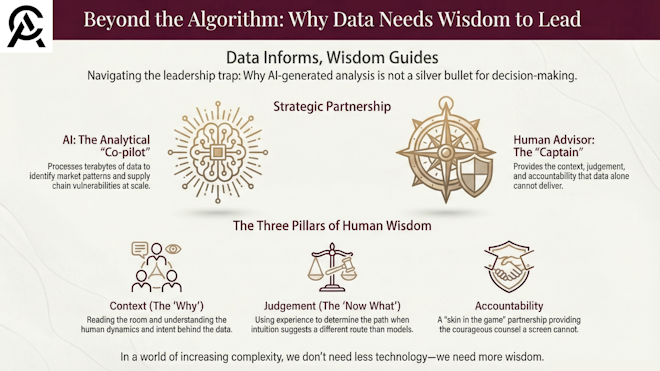
The future of effective leadership is not a choice between AI and human advisors; it is a strategic partnership between the two. The smartest leaders are learning to use AI as a powerful analytical co-pilot, and a seasoned human advisor as the experienced captain.
AI is the “What” — The Ultimate Analytical Engine
We must be clear about what AI does brilliantly. It is an analytical engine unparalleled in human history. It can:
- Analyse thousands of customer data points to identify churn risks.
- Model the financial impact of three different market-entry strategies.
- Scan global supply chains for hidden vulnerabilities.
AI provides the “what.” It delivers the objective, data-driven facts of the situation with a speed and scale that no human can match.
The Human Advisor is the “Why” and the “Now What”
Where AI stops, the human advisor begins. A seasoned advisor—someone who has navigated market crashes, led turnarounds, and built cultures—provides the three things that data alone cannot:
- Context (The “Why”): Data is silent on intent and culture. An advisor understands the nuance of why something is happening. They can read the room, understand the political landscape of a board, and see the human dynamics that an algorithm will always miss.
- Judgment (The “Now What”): Knowing the data is one thing; knowing what to do with it is another. Judgment is the product of experience—the ability to look at an AI-generated model and say, “The data suggests X, but based on what I’ve seen in similar markets, we should do Y.”
- Accountability: You can’t fire an algorithm. High-stakes leadership requires a “skin in the game” partnership. A human advisor stands alongside the leader, providing the courageous counsel and moral support that a screen never can.
The Collaborative Advantage
The most resilient businesses will be those that integrate both. They will use AI to strip away the noise and provide a clear, data-driven foundation. They will then use seasoned human advisors to interpret that data through the lens of experience, empathy, and strategic judgment.
In a world of increasing complexity, we don’t need less technology, but we do need more wisdom. The future belongs to the leaders who can use AI to tell us the “what,” and then relying on experienced, empathetic leaders to understand the “why” and determine “how” to move forward.
Data informs the decision, but wisdom guides the action.